What a stoop is, structurally
A classic brownstone stoop is a masonry structure — a solid or filled body of brick and stone — carrying a run of treads and risers up to the parlor floor, usually with cheek walls on one or both sides. Over that structure sits the working surface: traditionally a brownstone finish, built up in coats over a prepared base. The finish is what you see and what you walk on; the structure is what holds it. Nearly every stoop decision reduces to one question: which of those two has failed?
Signs the finish has failed — a repair (or resurfacing) scope
When the structure is sound, stoop failure is almost always the finish coat letting go:
- The surface is patchy and peeling — areas of finish delaminated, worn through to different material beneath
- Spalling and flaking across treads and risers, worst where feet and weather hit
- Edges and nosings soft or rounded off from a century of use
- The stoop still sits true: no tilt, no gap where it meets the building, treads level and solid underfoot
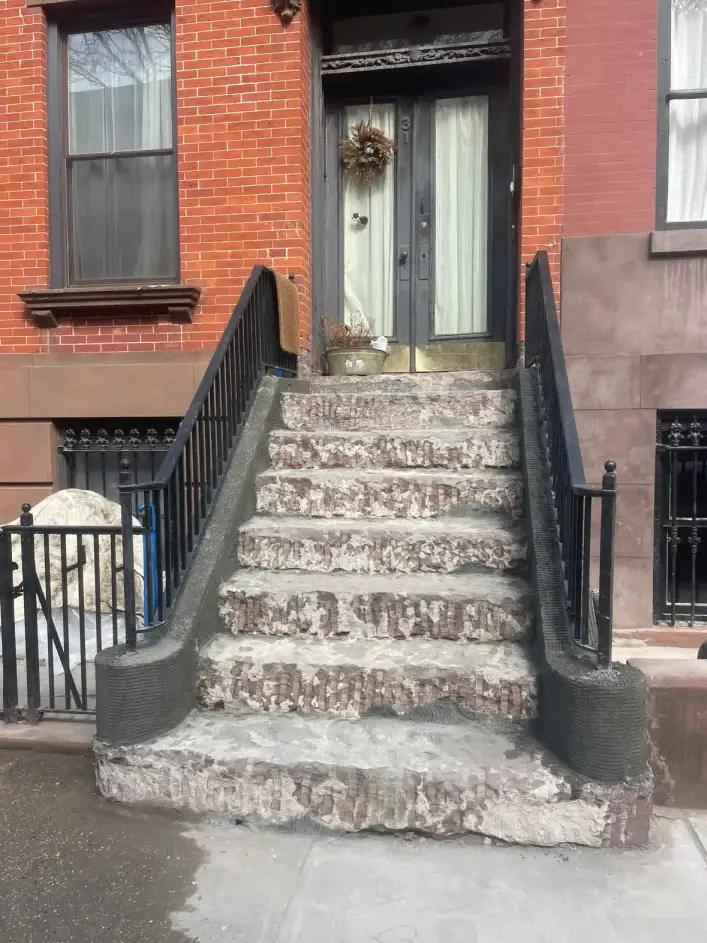
This was the pattern at 233 Bergen Street. The finish coat had failed on every tread and riser — delaminated, peeling, the stone worn through in patches — while the building itself, a red-brick rowhouse with its original stoop, stood sound behind it. The scope was resurfacing: the failed surface taken back, a fresh base coat applied tread by tread with its keyed texture for bonding, then the full run finished in a smooth brownstone tone. Structure kept; surface renewed. You can watch the stages and the finished result in the 233 Bergen Street case study.
Signs the structure has gone — a rebuild scope
Structural failure reads differently, and no finish coat will fix it:
- The stoop has settled, tilted, or pulled away from the facade — the gap at the building line channels water straight to the foundation wall
- Treads cracked through, rocking, or hollow-sounding across the run
- Cheek walls bulging, displaced, or cracked through rather than surface-worn
- Soil or fill beneath washed out or compacted — the undermining that causes the settlement in the first place
- The masonry body itself crumbling, not just its coat
At 31 South Oxford Street, the stoop presented worn, patchy, and spalling — and the correct scope was to take it back to sound structure and rebuild: the deteriorated material stripped away, a scratch coat established over the treads, and the crew hand-applying the brownstone coating to bring the whole run back to one sound, uniform structure. The before-and-after pair, photographed from the same spot, shows how much more than a surface treatment that stoop needed — see the 31 South Oxford Street case study.
How a mason decides
The reading is physical, and it happens before any quote:
- Sound the structure. Treads and cheek walls are tapped and probed — solid masonry rings; failed masonry sounds hollow and crumbles.
- Check the lines. Is the run level? Is there a separation gap at the facade? Has the base settled?
- Read the finish separately from the body. A finish can be destroyed over a sound structure (Bergen) or cosmetically tired over a failed one — the two judgments are independent.
- Find the water. Most stoop failure is water at work — through open joints, off a failed cap, into a separation gap. Whichever scope is chosen, the water path gets closed as part of it, or the new work inherits the old problem.
The cost of choosing wrong
Under-scoping a structural stoop — coating over a body that is settling or crumbling — buys a finish with a short life: the movement continues, the new coat cracks along the old lines, and the owner pays for the rebuild anyway, minus the wasted repair. Over-scoping a sound stoop — demolishing structure that only needed its surface renewed — spends demolition and rebuilding money on a resurfacing problem. The probing takes minutes. It is the cheapest part of the job and the one that decides everything after it.
What each scope involves
Repair / resurfacing: failed finish removed to a sound base; base (scratch) coat applied and keyed; finish coat in the brownstone tone, edges and nosings re-formed; joints and the meeting line at the facade sealed.
Rebuild: deteriorated material stripped back to sound structure — or the failed sections taken down; the structure rebuilt on a sound footing and base; scratch coat built up; brownstone finish applied over the full run; cheek walls, caps, and the facade junction made good.
Both scopes end the same way: a stoop that sheds water, reads as one piece of masonry, and matches the building it serves. Perfect Construction USA Corp restores and rebuilds brownstone stoops across Brooklyn as part of its masonry practice. If you are looking at a stoop and cannot tell which scope it is, that is exactly what a free on-site estimate is for — call (347) 335-8089, or read more on our masonry & concrete page.